For travelers eager to explore the imposing Inca Citadel of Machu Picchu, here is an overview of its main attractions and must-see landmarks. While much of what we know today comes from archaeological research, many aspects of the citadel remain a mystery. Fortunately, the Spanish conquistadors never reached this wonder of the world, allowing its structures to remain remarkably well preserved centuries after its abandonment.
As mentioned in our Machu Picchu travel guide, the Inca Sanctuary is divided into agricultural, administrative, residential, and religious sectors, each with its own architectural layout and purpose.
Inca engineers built the entire citadel atop an advanced system of terraces designed for both structural stability and agriculture. This ingenious design enabled Machu Picchu to withstand centuries of earthquakes and erosion. Experts continue to marvel at the construction techniques used—particularly the precision stonework assembled without mortar.
Although Machu Picchu offers a glimpse into daily life during the Tahuantinsuyo Empire, it also conceals countless secrets left behind with its abandonment. Read on to uncover the mysteries of the legendary “Lost City of the Incas” and prepare yourself for a journey back in time.
Things to See in Machu Picchu
Located within the residential sector, this is the largest and one of the most refined structures in Machu Picchu. Its fine masonry and architectural sophistication suggest it was a royal residence—possibly home to the Inca emperor Pachacutec.
Nearby lies the Acllahuasi, believed to have housed the Acllas (Chosen Women), who were dedicated to religious duties. Archaeologists inferred this function based on the structure’s layout and construction style.
2. Sacred Plaza
This large esplanade separates the residential area from the ceremonial sector. The Sacred Plaza is believed to have been a religious and ceremonial center, surrounded by some of the most important structures in the citadel, including the House of the High Priest, the Temple of Three Windows, and the Acllahuasi.
3. Temple of the Three Windows
Located within the Sacred Plaza, this temple is thought to symbolize the three realms of Inca cosmology: Hanan Pacha (the upper world), Kay Pacha (the earthly world), and Ukhu Pacha (the inner world). It is also associated with the myth of the Ayar brothers, the legendary founders of the Inca civilization.
Excavations revealed ceremonial and everyday artifacts buried within the structure. Interestingly, four names were once carved into one of its stones—evidence that outsiders visited Machu Picchu years before Hiram Bingham’s 1911 expedition. These inscriptions were later removed.
4. Temple of the Sun
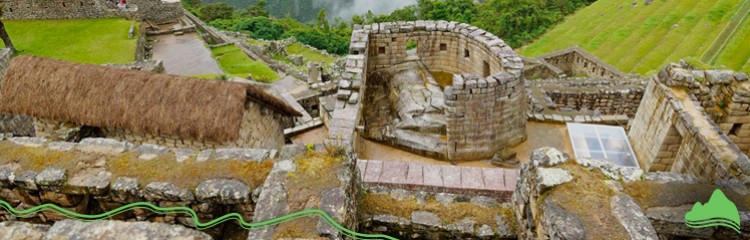
One of the most impressive structures in Machu Picchu, the Temple of the Sun is known for its curved walls and masterful stonework, resembling the architecture of the Qoricancha in Cusco. This led Hiram Bingham to believe it served as a solar worship temple.
The temple features three windows: two align with the sun during the summer and winter solstices, while the third—known as the “Snake’s Window”—contains small perforations that may have once held precious stones.
Built atop a natural cave, the structure may have served as a mausoleum. Some historians suggest it could have been the burial site of Emperor Pachacutec.
5. Intihuatana
Located at the highest point of the citadel, the Intihuatana is one of Machu Picchu’s most enigmatic features. This carved stone is believed to have been used as a solar observatory and ritual site.
During the winter solstice, the Incas likely gathered here to honor Inti, the Sun God, performing ceremonies and offerings to ensure the sun’s return. The stone’s precise alignment reflects the Incas’ advanced astronomical knowledge.
6. Temple of the Condor
Situated in the urban sector, this structure derives its name from the stone formations that resemble an Andean condor with outstretched wings. Inside, archaeologists discovered a dungeon-like space, suggesting it may have served as a place of punishment.
Given the condor’s sacred status in Inca mythology, it is believed that rituals or sacrifices were performed here, possibly involving enemies of the empire.
7. Royal Tomb
Located beneath the Temple of the Sun, the Royal Tomb was described by Hiram Bingham as one of the finest stone structures in the Americas. It features exquisitely carved stonework, a two-level altar, and a symbolic staircase carved into the rock.
Although no mummies were found, archaeologists believe it may have been a ceremonial site or burial place for elite members of Machu Picchu society.
8. Sacred Rock
The Incas revered the surrounding mountains, known as Apus, as protective spirits. The Sacred Rock is a massive stone carved to resemble Mount Putucusi, which rises behind it.
While its exact purpose remains unclear, its location and symbolic form suggest it played a ceremonial role in honoring the Apus.
9. Watchman’s Hut
This small structure sits near the entrance to the citadel and overlooks the entire complex. Archaeologists believe it functioned as a control point to monitor access to Machu Picchu.
10. The Inca Bridge
The Inca Bridge is a wooden platform supported by stone walls, suspended over a sheer 300-meter drop. It once served as a defensive entrance connected to the Inca Trail.
For safety reasons, visitors cannot cross the bridge, but it can be admired from a nearby viewpoint.
Machu Picchu is home to more than 200 architectural structures, many of which remain astonishingly intact despite centuries of abandonment.
Our Private Machu Picchu Tours guide you through the most remarkable areas of the citadel, revealing hidden details and ancient secrets along the way.
At Viagens Machu Picchu, we are committed to delivering authentic and unforgettable travel experiences throughout Peru. Explore our travel packages and start planning the journey of a lifetime.